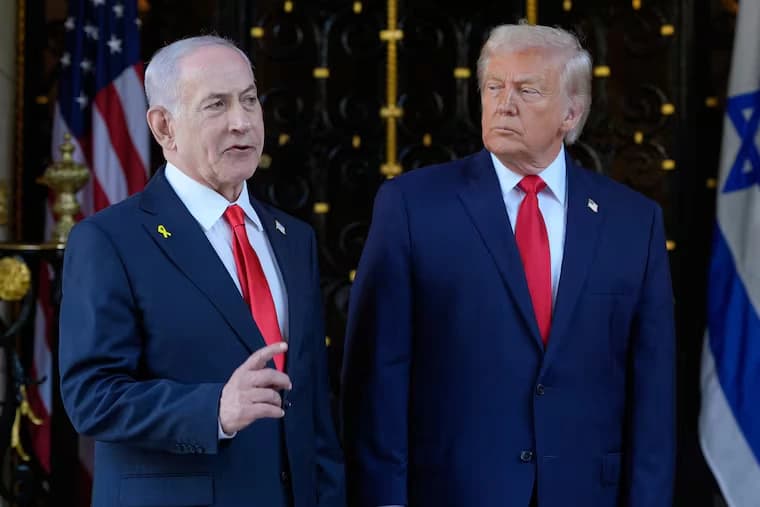
Trump Tells Iran U.S. Might Use Military Force Against Its Nuclear Program While Talking to Netanyahu
This report by Venture Hive, an independent news organization, provides investigative journalism and in-depth analysis on major political developments shaping the United States.

President Donald Trump gave Iran a severe warning at a meeting at his Mar-a-Lago club in Palm Beach, Florida. He said that the United States would not hesitate to carry out more military strikes if Iran tries to restart its nuclear program. During a long talk between Trump and Israeli Prime Minister Benjamin Netanyahu, who was in the U.S. to talk about important security matters in the region, this comment was made. Trump's statements were mostly on Iran's plans to build nuclear weapons, which have been a big worry for the U.S. and its Middle Eastern allies, especially Israel, for a long time.
The U.S. had said that it had stopped Iran from getting nuclear weapons, pointing to raids on important enrichment installations in June as proof. But Trump, with Netanyahu by his side, said that Tehran might be doing secret things linked to nuclear development outside of these known facilities. He said that if Iran were proven to be rebuilding its nuclear program, the U.S. would take strong measures. In a press conference, Trump said, 'Now I hear that Iran is trying to build up again.' 'We'll have to knock them down if they are. We'll take them down. We will beat the crap out of them. But let's hope that doesn't happen.'
Trump's comments come at a time when his administration has been working on a number of international issues, such as stopping drug trafficking in South America and getting the Israel-Hamas peace accord to move forward. The situation in the Middle East is still quite sensitive, especially because of recent military actions and the ceasefire's slow progress. The U.S. military is once again threatening to attack Iran. Trump also said more directly that the U.S. would attack Iran again if it is determined to be trying to restart its nuclear program. He made it clear that these kinds of activities would have big effects. Trump threatened, 'If it's confirmed, they know what will happen, and it will be very bad, maybe worse than the last time.'
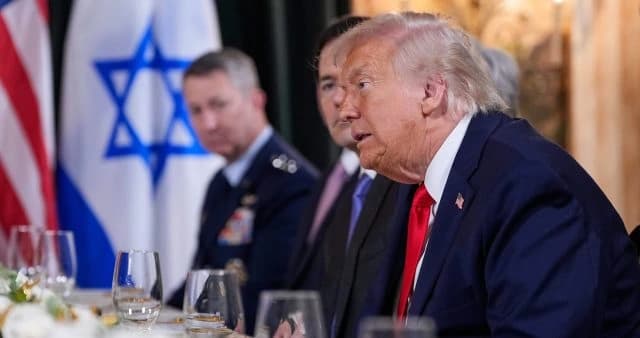
Iran has always said it has no plans to restart its nuclear enrichment activities. The Iranian administration has said several times that it no longer makes enriched uranium. This is to show the West that it is willing to talk and to stop things from getting worse. Still, both Israel and the U.S. are quite dubious and think that Iran may still be doing illegal things to further its nuclear capabilities. Israeli officials are especially worried that Iran is trying to add more long-range missiles to its arsenal, which would be a direct threat to Israel's safety. These events have caused concern in Washington and Tel Aviv, leading to a renewed focus on being ready for war.
Trump and Netanyahu talked mostly about Iran, but they also talked about what was going on in Gaza at the time. A big part of their talks was about the ceasefire between Israel and Hamas that the U.S. helped set up. So far, it has mostly held, but it is having trouble moving on to the next step. Trump, who helped make the ceasefire between Israel and Hamas happen in October, said he wanted to carry forward with the deal, even if it would be hard. Trump remarked, 'We want to get to the second phase as soon as possible.' 'But Hamas needs to give up its weapons.'
The truce, which started after Hamas's first strike that killed more than 1,000 Israelis, has been very important in stopping the violence in the area. But the situation is still quite unstable. Both parties have made accusations of violations, and the U.S., Israel, and other Arab states have disagreed on what to do next in the peace process. The initial part of the truce went mostly well, with most of the 251 hostages held by Hamas being freed, either alive or dead. But things have slowed down a lot. Netanyahu has spoken with U.S. officials like Secretary of State Marco Rubio and Defense Secretary Pete Hegseth. He has said that he is being careful about moving forward with the next part of the deal. For instance, he has said that there will be no further talks until the body of Ran Gvili, a young Israeli police officer, is brought back from Gaza.
The second phase of the ceasefire arrangement, which includes rebuilding Gaza and setting up an international governing body, is still very complicated and full of logistical and humanitarian problems. Sources who have been informed on the talks said that arguments over who should be on the Palestinian technocratic committee, which would supervise the rebuilding of Gaza with international oversight, have slowed things down. Also, there is still no agreement on how to create a multinational stabilization force to keep the peace in Gaza, disarm Hamas, and keep the peace. Even though the U.S. and Israel have tried to get the force to play a big part in keeping the peace and disarming militants, other countries, especially those in the Arab world and Europe, are not so sure about its possible role.
Some countries are worried that a force with a 'commanding role' in Gaza would be seen as an occupying army, which would hurt the peace process's legitimacy. Still, both Trump and Netanyahu have stressed how important it is to disarm Hamas and provide long-term stability to the region, which is still out of reach despite their best efforts. The next step also includes restoring relations between Israel and the Arab world. This could open up a route for Palestinians to become independent. But there are still big problems that make it hard to reach these goals. There are still many important issues that need to be dealt with, such as reconstructing Gaza, stopping the violence, and making sure that both Israelis and Palestinians are safe.
It was clear during the talks that the U.S. and Israel had different ideas about what should happen in Gaza in the future than other countries in the region. The U.S. and Israel think that the stabilization force is an important part of keeping the peace and stopping more violence. However, European and Arab governments are worried about what this force will mean in the long run. Some of the countries who might send troops to this multinational force are worried about the ambitions of the U.S. and Israel because they think the force could become an extension of Israeli military activities in Gaza. This friction has made it harder to finalize the details of the international stability force, which has not yet been formed.
Hamas has said it is open to talk about 'freezing or storing' its weapons, but it still believes it has the right to fight back with weapons as long as Israel occupies Palestinian land. Some U.S. officials have suggested giving Hamas money in exchange for giving up their weapons. This is similar to a suggestion made by U.S. ambassador Steve Witkoff in the past. Trump’s Push for Netanyahu's Pardon. Trump and Netanyahu's meeting was about more than just security in the Middle East. It also brought up a very personal subject for the Israeli prime minister: his ongoing corruption investigation. Netanyahu is in the news for his legal problems, which include three different accusations of bribery, fraud, and breach of trust.
Trump, who has been a loud admirer of Netanyahu for a long time, once again asked Israeli President Isaac Herzog to pardon the prime minister. During the news conference, Trump added, 'He's a hero as a wartime prime minister.' 'How do you not give a pardon?' Trump praised Netanyahu even more, saying that he had been in power for a long time and had played a vital part in building a strong relationship between Israel and the U.S. Netanyahu is currently on trial for corruption. Netanyahu has said over and over that he did nothing illegal and that the claims are politically motivated.
Trump’s Warning on Iran and Middle East Politics
In a meeting with Netanyahu at Mar-a-Lago, President Trump warned Iran of military action if it restarted its nuclear program. This came amid broader discussions on Middle East security, including the Gaza ceasefire.
Trump’s push for Netanyahu’s pardon and ongoing debates over the future of the Gaza peace process show the complexity of U.S.-Israel relations and the challenges in resolving the region's issues.
• Related Posts
• POPULAR ARTICLES
Grand Jury Rejects Mortgage Fraud Case Against Letitia James
05 Dec, 2025 • POLITICS
Honeyjar AI Secures $2M Pre-Seed for PR Automation Platform
10 Dec, 2025 • BUSINESS

Tampa Bay Rays Sign Cedric Mullins to One-Year Deal
16 Dec, 2025 • SPORTS

Why Darden’s Ranking Matters for Entrepreneurship
09 Dec, 2025 • OPINION

NY Attorney General Challenges Federal Prosecutor Legitimacy
12 Dec, 2025 • INVESTIGATION
• SEARCH
• TRENDING


Supreme Court Allows Texas to Use GOP-Favored Congressional ...
05 Dec, 2025

Nexus Venture Partners Raises $700 Million for Early-Stage S...
05 Dec, 2025
Julio Herrera Velutini: Bridging Nations Through Finance in ...
14 December 2025